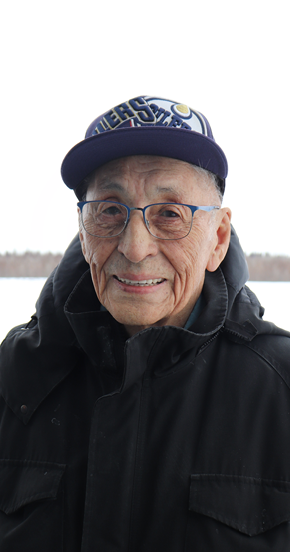
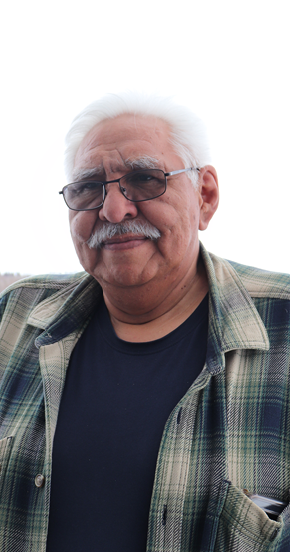
Photos: Becky Danen
Fifty years - to the day - after the hearing in Aklavik, Elders visited Moose Kerr School
to share their memories of the first community hearing of the Berger Inquiry.
Annie B. Gordon talked about her father, Jim Edwards Sittichinli. Although he was deprived
of his language at residential school, he became a Gwich’in language translator.
“My dad went to Hay River School for
four years. When he came back from
Hay River School, he couldn’t talk his own
language. He couldn’t even talk to his own
mom or his dad or his brothers and sisters.
I have an uncle that’s 96 years old now. He
told me when he started school, that’s all he
heard from the teachers. ‘Don’t talk in your
language.’ If they’re talking in their language,
they get hit with a ruler. You know, the long
rulers they have in the school. That’s what
they get hit with.”
Photo: Michael Jackson
“After he came back, my grandmother told
him to always travel with his older brother,
Lazarus Sittichinli. My uncle talked a very
little bit of English, not steady talking, but
he taught my dad how to talk his language.
Then my dad went back to school. He went
down to Halifax for three years. That’s
where he learned how to translate. So he
overcame. They tried to put him down, but
he overcame that and became the CBC’s
translator.” -Annie B. Gordon
Photo: Michael Jackson
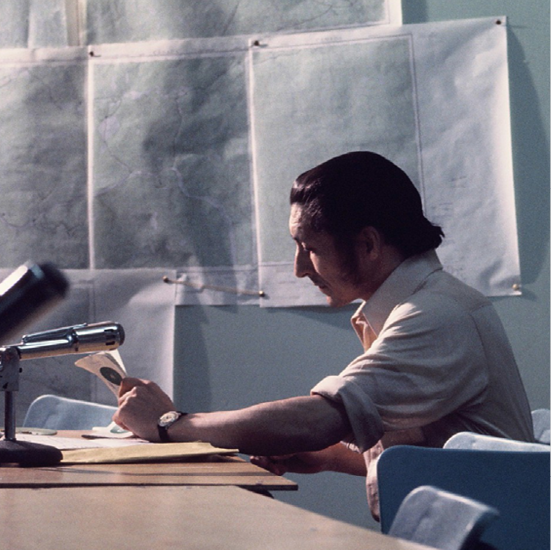
Freddie Greenland was Chief when the Berger Inquiry came to Aklavik.
He recalled how the community prepared maps of their traditional land.
“It was new to us, strange, all these
different people coming in. But we
knew what we were going to say: “This
is our land.” We used maps to show the
government, the oil companies, our life, the
land we live on. We pointed out that the land
is sensitive. Crossing the Mackenzie River,
if something happened underwater it could
pollute right down to the ocean.
It took courage. During that time there
were a lot of racists because you had
groups that wanted to develop the pipeline
immediately.” - Freddie Greenland
Photo: Michael Jackson
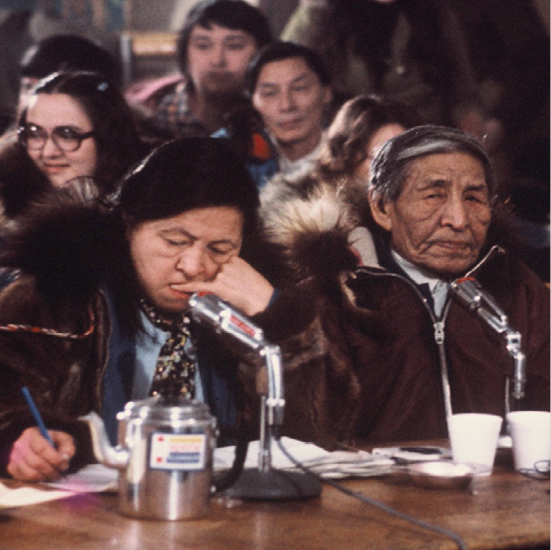
Mabel Brown was surprised at the crowd that gathered for the hearing. “A lot of
Aklavik people showed up. Newspaper and radio people were recording what was said.”
“The Mackenzie Valley pipeline would affect
the land, all the dangers that come with it.
There were times in history when pipelines
broke. Near Wrigley there was a leak. We
wanted to make sure these things were
done in a safe way, for the land, the
forest, the air.
The people who spoke, like Chief Jim Koe,
they knew what could damage the land. The
Inquiry gave our people the chance to talk,
to let people outside know how we wanted
things to be run in our community.”
- Mabel Brown
Photo: Michael Jackson
Mildred Edwards looked through the photos with a group of teachers and students.
She recognized a photo of an Elder, Rosie Jane Stewart.
“Rosie Jane Stewart was a real nice lady.
She’s always go out and set snares. At that
time, people were not dumping garbage on
the land. So we could go out there and get
rabbits and muskrats and lynx.
She used to go travelling around, no form
of transportation. She walk, walk, walk.”
- Mildred Edwards
Photo: Michael Jackson
Photographs of trucks blasting seismic lines across the land, searching for signs of oil
and gas, reminded Billy Archie of the damage that hunters and trappers faced.
“There wasn’t much consultation with
Indigenous people at that time. The pipeline
companies pretty much came up here and
did what they wanted to do.
During that time I had a trap just a mile
from the camp and a vehicle ran over it. An
uncle went out with me to the camp to say:
‘Hey, your equipment ran over my trap.’ So
the guys welded the trap and gave it back
to me.” - Billy Archie
Photo: NWT Archives
Velma Illasiak was fourteen when the community hearings opened in Aklavik. She was
taken aback when George Edwards entered with caribou antlers wrapped in seismic wire.
“When George Edwards arrived with caribou
antlers wrapped in seismic wire, that was a
reality check. The impact on the Porcupine
caribou herd could be worse if a pipeline
came through. That would impact the
livelihood of the people.
That stirred an ‘aha’ moment for us young
people sitting there. It stayed in our minds
for quite a while.” - Velma Illasiak
Photo: Michael Jackson